
Application
Biomass Boiler
Biomass fuel encompasses various sources like wood, agricultural and food-processing byproducts, sewage sludge, and animal manure. Utilizing crop waste, sewage, or manure — readily available resources — to generate electricity holds environmental advantages. It aids in conserving precious landfill space and contributes to achieving “net-zero” overall CO2 emissions.
Biomass can undergo direct burning or be converted into gas before use. Power plants utilizing direct biomass burning employ boilers that produce steam for generators similar to those used with fossil fuels. In the process of biomass gasification, the material is transformed into methane (CH4), a versatile fuel for various power plant configurations: steam generators, combustion turbines, combined cycle technologies, or fuel cells.
One of the primary advantages of biomass gasification over direct combustion lies in the versatility of the extracted gases for use across different types of power plants.
Flowvision has a track record of delivering effective DeNOx systems for a broad spectrum of biomass boilers, ranging from small-scale straw-fired units to medium-sized ones running on wood chips, and large retrofitted biomass boilers. Leveraging extensive expertise in biomass combustion, Flowvision customizes DeNOx systems to align with the fluctuating temperature and emission profiles typical of biomass boilers. Flowvision has achieved NOx reductions exceeding 70% for biomass boilers using the Selective Non-Catalytic Reduction (SNCR) technology and above 90% with Selective Catalytic Reduction (SCR).
Flowvision's engineered systems stands out in this field, achieving NOx emission reductions of up to 96% with extremely low ammonia slip.
SNCR
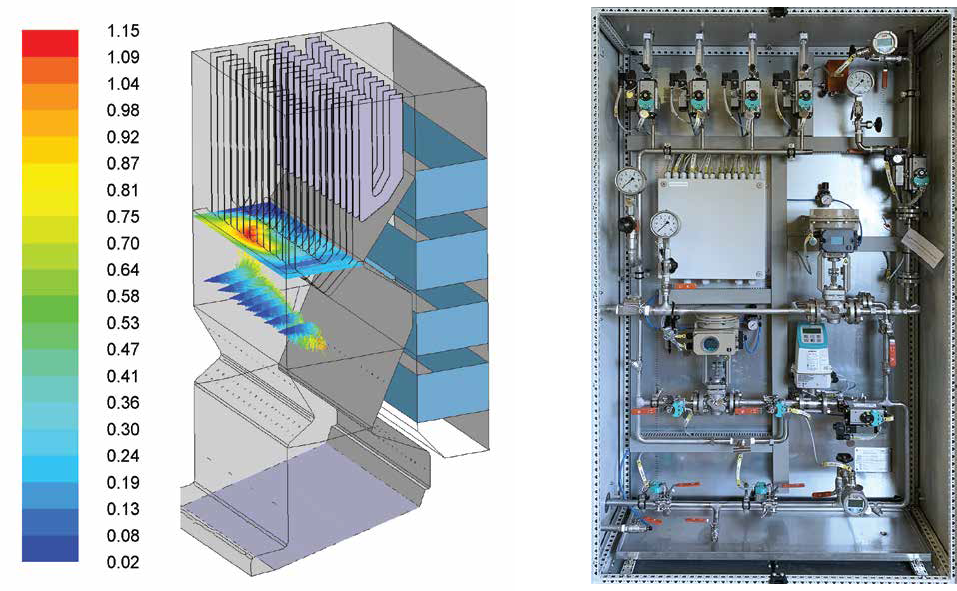
Flowvision leverages advanced temperature monitoring systems to precisely dose the reagent at the optimal temperature and flow rate. This feature significantly enhances the flexibility of our SNCR system, resulting in even higher reduction rates.
SCR
Flowvision provides tail-end SCR systems operable at temperatures as low as 150 °C. Many plant owners prefer this tail-end system, maintaining temperatures between 150 – 220 °C. Operating at such low temperatures poses the risk of ammonia bisulfate (ABS) formation. In such scenarios,
Flowvision offers a dedicated online catalyst regeneration system. This system utilizes duct burners, electric heaters, or steam coils, along with all necessary accessories, effectively addressing ABS formation concerns.