Product
Flue gas pre-treatment
Overview of Other Flowvision Flue Gas Treatment Technologies
Industries, especially those involved in power generation and manufacturing, must address the challenge of reducing pollutants in their emissions. Three prominent technologies included in Flowvision portfolio — dry scrubbers, wet scrubbers, and quenching systems — offer effective solutions for mitigating pollution from flue gas streams.
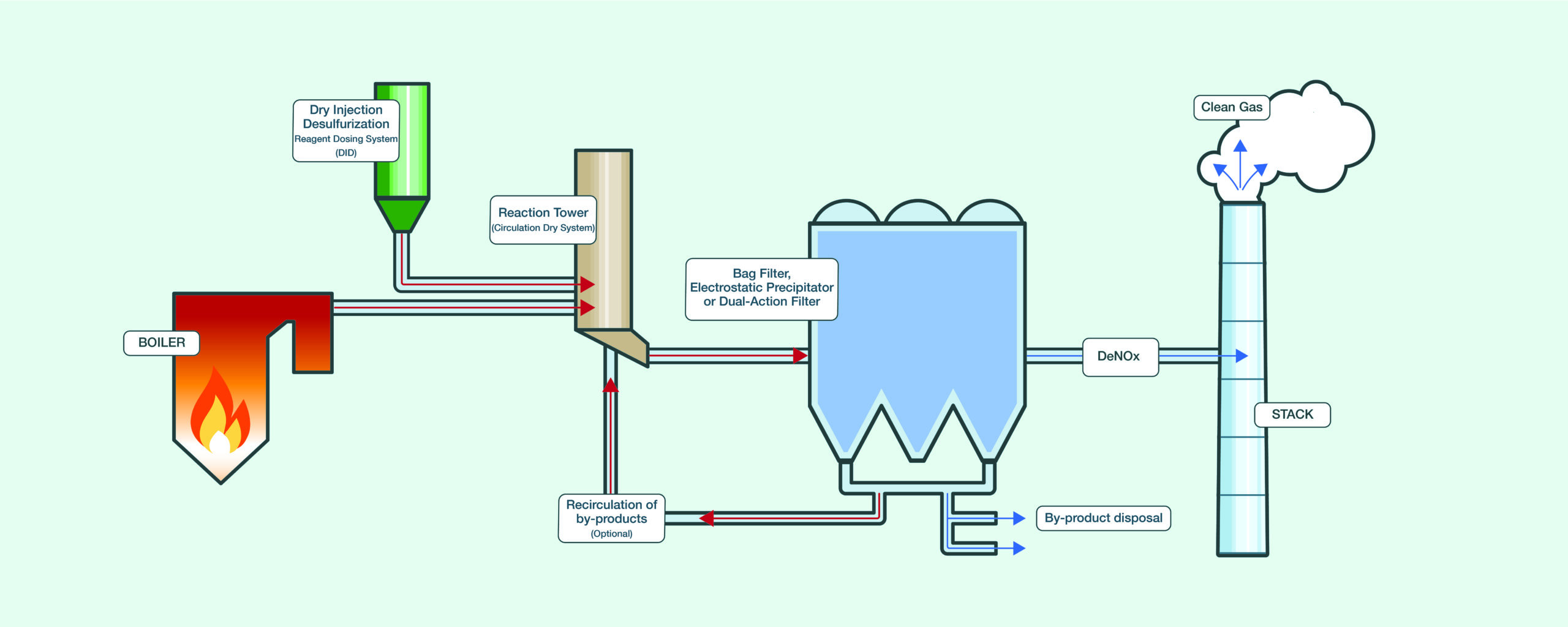
Dry Scrubber Technology
Application: Dry scrubbers are primarily used to remove pollutants like acidic gases (SOx, HF, HCl) and particulate matter without using liquid, which makes them more water—efficient compared to wet systems.
Mechanism: Dry scrubbers inject a sorbent (like lime or sodium bicarbonate) into the flue gas stream. The reaction between the sorbent and pollutants like sulfur dioxide (SO₂) neutralizes harmful emissions, which are then collected as solid waste.
Advantages:
-
Versatility:
Capable of treating various pollutants. -
Low Water Use:
As it doesn't require large volumes of water, it is suitable for industries with water constraints. -
Cost Efficiency:
Reduced operating costs due to simpler infrastructure and lower water usage. -
Compact Design:
Ideal for installations where space is a concern.
Challenges: Factors such as the type of sorbent and temperature variations can affect performance. The disposal of solid waste generated also requires careful handling.
Wet Scrubber Technology
Application: Wet scrubbers are highly effective in removing pollutants such as sulfur dioxide, particulate matter, and other water-soluble gases (HCl,
NH3 and others)
Mechanism: Flue gas is passed through an absorption tower where it interacts with a water-based scrubbing solution. Pollutants are absorbed or neutralized by the liquid, while a mist eliminator ensures that clean air is emitted. Additional chemicals can be added in order to detect specific pollutants in the flue gases.
Advantages:
-
High Efficiency:
Wet scrubbers are extremely efficient at capturing water-soluble pollutants, achieving up to 95% removal of particulate matter. -
Comprehensive Pollutant Removal:
Capable of addressing a broad spectrum of pollutants, including acidic gases and hazardous compounds.
Challenges: Efficient operation is dependent on the composition of flue gas and pollutant concentration. Managing the wastewater generated during scrubbing is essential to avoid environmental harm. To optimize water use, technologies like heat exchangers and closed-loop systems can be incorporated.
Quenching Technology
Application: Quenching technology is crucial for cooling hot flue gases and aiding in the removal of pollutants. It plays a pivotal role in minimizing corrosion risks and enhancing the efficiency of downstream pollution control systems.
Mechanism: In quenching systems, a cooling medium—typically water—is sprayed into the flue gas stream. The rapid evaporation of water cools the gas, facilitating the condensation of pollutants like sulfur dioxide and particulate matter, which can then be filtered out.
Advantages:
-
Emission Reduction:
Rapid cooling aids in converting sulfur dioxide from a gaseous to a particulate state, making it easier to capture. -
Efficiency:
Cooling flue gas enhances the performance of other pollution control methods, such as desulfurization.
Challenges: Water consumption and potential contamination are
considerations in the design of quenching systems. Careful management
of energy usage and maintenance is necessary for long-term operation.
Conclusion
Each of these technologies—dry scrubbers, wet scrubbers, and quenching
systems—offers unique advantages in flue gas treatment. The selection of
an appropriate system depends on the specific requirements of the
industry, including the type of pollutants, water availability, and regulatory
requirements. By combining these technologies Flowvision can help industries significantly reduce their environmental footprint while adhering to stringent emission standards.